


Why Trump can’t explain the start or endgame of the war in Iran

President Donald Trump has spent a lifetime talking himself out of tough spots. But in the war with Iran, his trusty technique of sowing confusion to postpone reckonings is beginning to fail.
Ten days in, Trump still hasn’t settled on a consistent rationale for why he went to war. Now, he’s hinting that peace might soon be at hand — even while he and top aides simultaneously warn the fighting might get more intense and last longer.
The messaging disconnect goes beyond Trump’s flood-the-zone rhetoric and odd tendency to commentate on his own actions. It reflects fast-escalating political and military pressures bearing down on a president who gambled his legacy on a war that has spawned a global energy and geopolitical crisis.
Tumbling stock markets and spiking oil prices have raised the possibility that a prolonged conflict could shatter the global economy. Days of Iranian retaliatory drone and missile strikes on Gulf states stoked fears of a wider conflagration.
The political clock is now ticking faster inside the United States, where Trump and his allies fret that reverberations will worsen the cost-of-living misery that threatens the GOP’s midterm election prospects.
Trump tries again to explain the war
With each passing day, Trump’s war aims — as impenetrable as they may be — seem ever more incompatible with his political stature, as polls show majorities of Americans never wanted to go to war again.
So Trump had another stab on Monday at explaining to Americans why their troops are at war in the Middle East.
At a Florida news conference, he argued — without evidence — that if he hadn’t launched the attack on Iran, the Islamic Republic would have taken over the entire Middle East. There’s no doubt that Iran, if armed with ballistic missiles and a nuclear weapon, would represent an existential threat to Israel and the rest of the world. But Trump has produced no evidence to show it was anywhere near that point.
In fact, many analysts believe one reason the war erupted was that Iran was weaker than at any time in the almost 50-year history of the Islamic Republic. Israel has already pummeled its regional proxies Hamas and Hezbollah, and sanctions had driven its economy and society to near breaking point.
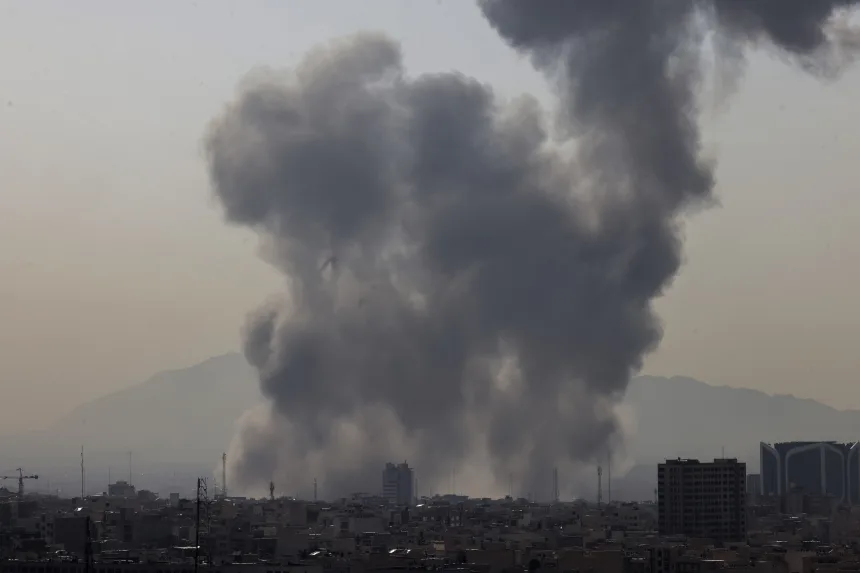
Trump also seemed to understand that Americans’ patience is limited. He insisted, “We’re ahead of our timeline by a lot” and billed the war as an economic winner.
“We’re putting an end to all of this threat once and for all. And the result will be lower oil prices — oil and gas prices for American families,” Trump insisted. “This was just an excursion into something that had to be done. We’re getting very close to finishing that, too.”
But he also repeatedly spoke of the war in the past tense, as if he wished it were already over.
A jarring question Trump must answer
Trump’s rhetorical fog of war contrasts sharply with the methodical and relentless US and Israeli air campaign that is inflicting catastrophic damage on the Islamic Republic’s war machine. These are plans refined for decades. Trump’s leadership, in contrast, evolves by the hour.
There could, at a pinch, be rational explanations for the messaging mayhem.
Perhaps Trump is seeking to confuse the enemy ahead of possible future escalations: CNN reported Monday, for instance, that the White House was mulling a complex and risky mission to retrieve Iran’s highly enriched uranium.
Or his hints at an approaching combat halt could be a shrewd play to mitigate political and economic heat. He told a CBS News reporter on Monday afternoon that the war was “very complete.” Within minutes, oil prices eased and stock markets pared losses, which didn’t seem like a coincidence.
But as the conflict grinds through its second week, the key question is not necessarily about whether Trump wants to end the war, but whether he can.
First, the US must assess whether its operational gains have sufficiently degraded Iran’s capacity to threaten its neighbors and US allies in Europe and eventually the US mainland. There are so far no independent battle damage reports. But Trump may have a case that the assault degraded Iran’s missile, nuclear and drone programs and the military infrastructure of its brutal regime.
This alone pushes off an existential threat against Israel and may make the world safer. And a successful US special forces raid to pull out Iran’s enriched uranium would set back any attempt to reconstitute its nuclear program for many years.
Is Trump willing to walk away from regime change?
But there are more fundamental questions about the war’s endgame facing Trump.
In short: Was this a war about ending Iran’s regime, or just its current threat?
Trump has often implied the former.
The assassination of Supreme Leader Ayatollah Ali Khamenei looked like an attempt at regime change in action.
Trump, meanwhile, has several times demanded the total surrender of Iran’s government.
He’s also pitched for an unlikely but decisive role in choosing a new leader in Tehran.
And he’s mulled about the possibility of a Venezuela-style scenario where he might rule Iran from a distance through a puppet leader.
Such possibilities always seemed highly unlikely and betrayed a misunderstanding of the internal power dynamics of a nation that might be oppressed but also features a strong nationalist streak.
By any measure, Tehran’s current political reality is well short of Trump’s goals. And the Islamic regime has never had qualms about sacrificing its own people, notably during the Iran-Iraq war in the 1980s. For the regime, survival means victory.
No one from the outside can know its true state after days of aerial pounding of government facilities and heavy loss of life.
But so far, the operation has succeeded only in replacing an aged supreme leader — who was already close to his eternal rest and had no succession plan — with a younger version with the same last name.
The message Iran’s clerics sent to Trump
The choice of Mojtaba Khamenei to succeed his martyred father as supreme leader was a signal of defiance from the theocracy and the Islamic Revolutionary Guard Corps that rule Iran with an iron fist.
It remains unclear how Khamenei will be able to consolidate power in such extreme circumstances. His medical condition is also unclear. He was believed to have been injured in the strike that killed his father, mother and other relatives. But in theory, Khamenei could rule for years to come.
Of course, Khamenei’s life expectancy may be measured in hours given Israel’s hints that it will try to kill him. But his accession was a rebuke to Trump’s demands to choose Iran’s leaders or for it to produce a new ruler who’d do a deal with him.
“This is not a one-assassination regime,” Karim Sadjadpour, an Iran expert at the Carnegie Endowment for International Peace, told CNN’s Erin Burnett on Monday. “It is a regime that is dug in right now. They believe it is kill or be killed, and I think they will find a replacement for him.”
History shows that it’s often impossible to identify when revolutions are brewing in advance — the US was surprised, for example, when the Soviet Union fell. But there’s no outward sign that the uprising of Iranians against their corrupt and repressive rules that Trump sought to trigger is about to materialize.
Perhaps US and Israeli attacks on Iranian economic and energy infrastructure could so weaken the regime’s foundation that a revolt could materialize in the months and years ahead, even if the clerics cling on for now. But this requires Iranian civilians taking to the streets against ruthless security forces pining for revenge following the US onslaught. Only weeks ago, thousands were killed in a previous thwarted uprising. It seems just as likely that the unintended result of the war will be more repression rather than a flowering of freedom.
Trump also faces pressing strategic dilemmas. Will he use force to try to open the Strait of Hormuz — the world’s vital oil conduit, which has been all but closed by Iran? And would the survival of the regime lead to an almost permanent state of simmering warfare between the US and Israel and Iran that requires regular escalations to prevent the Islamic Republic rebuilding its threat?
There’s precedent here. After the 1990-91 Gulf War, US pilots spent years patrolling no-fly zones in the south of Saddam Hussein’s Iraq. Successive US administrations conducted anti-terror campaigns in Iraq and Syria against ISIS.
Seth Jones, a former senior US adviser in the Afghan war, drew an analogy with Israel’s years of operations against Hamas in Gaza and Hezbollah in Lebanon. “I just don’t think we are close to this being over,” he told CNN’s Burnett.
Perhaps this gets at the reason for Trump’s confusing war messaging.
The president might want it to be done — but he likely knows it isn’t.