


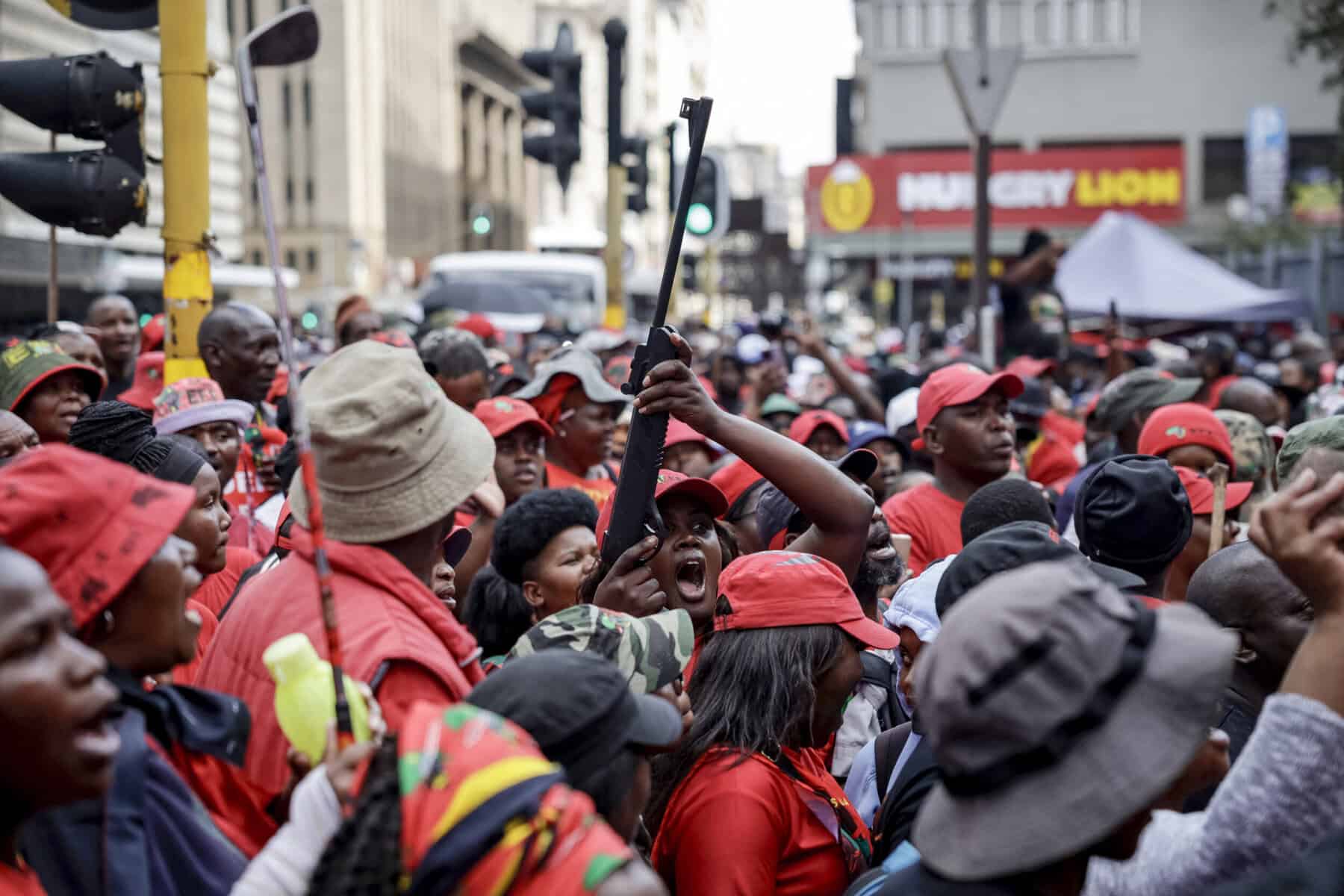
What now for Malema and EFF?
Analysts say the legal battle could reshape both Malema’s image and the EFF’s political future
Julius Malema left the regional court in KuGompo, formerly East London, yesterday in angry mode, hitting out at magistrate Twanet Olivier after she sentenced him to five years’ jail, accusing her of bias, and that her remarks went beyond legal reasoning and reflected political or emotional considerations.
Sentence was passed after his conviction for firing an assault rifle into the air during an EFF rally at the Sisa Dukashe Stadium in Mdantsane on 28 July, 2018.
Malema attacks court after sentencing
Of Olivier, Malema said outside court: “She goes around fund-raising reasons why we must go to prison.”
He claimed the magistrate had “just entered the court without knowing what was contained in the heads of arguments”, going on to suggest that her sentence may not have been independently written, saying it was penned by an “invisible hand”.
Malema added that Olivier should be reported to the Magistrate’s Commission.
“We are done with her [Olivier]. That’s why when she said to me, ‘you can leave now on free bail’, I looked at her and said ‘bye-bye’ because I had seen her ugly face for too long.
“So I will no longer appear before that ugly white face. I’m going to the highest court, where they don’t use emotions; they use the law.”
He also criticised state prosecutor Joel Cesar, whom he described as “arrogant” and said suffers from “short-man syndrome”.
Legal process and political implications
Whether those remarks might be interpreted as contempt of court remains to be seen, but the fact that Malema was granted leave to appeal the sentence – but not his conviction – means that at least he doesn’t immediately lose his position as an MP.
Parliamentary rules state any custodial sentence without the option of a fine in excess of 12 months means an MP loses their seat for a period of five years after the sentence is served.
But Malema’s political future is still safe for now, according to an expert.
Analysts weigh impact on EFF
Analyst Goodenough Mashego said the court drama might actually boost Malema’s popularity because he will be trying to spin it in his favour by playing a victim.
“He will now start talking about how he was targeted by the authorities for being outspoken about critical issues that affect the country. Looking at how the EFF members and supporters think, they will turn against him. He is going to appeal and that might be a long campaign.
“This might affect the party in the long run, not now. The EFF already started losing support and it might continue, but not because of this ruling.”
Theo Neethling, a research fellow in political studies and governance at the University of the Free State, said the sentencing has immediately triggered a predictable, yet politically significant response, underscoring both the legal and political stakes involved.
Malema has described the judgment as “flawed” and politically motivated – a line of argument consistent with his defence throughout the trial, Neethling said.
“Procedurally, Malema is unlikely to face immediate incarceration. His bail is expected to be extended, pending the outcome of the appeal.
“This allows him to remain politically active during what may become a protracted legal process. However, the longerterm implications of the sentence – should it be upheld – are potentially far-reaching,” Neethling said.
EFF’s political standing
“A custodial sentence exceeding 12 months could lead to his disqualification from the National Assembly, a scenario that would dramatically reshape parliamentary dynamics and alter the political standing of the EFF.
“Beyond parliamentary consequences, the judgment introduces a layer of uncertainty into the EFF’s leadership at a particularly sensitive political moment,” Neethling said.
“With the local government elections on the horizon, any disruption to his leadership could complicate campaign strategy, messaging and internal cohesion.”
The EFF has historically been closely identified with Malema’s personal leadership style and legal pressures on him inevitably translate into broader institutional uncertainty for the party.
However, despite these challenges, Malema said he intends to continue pursuing his political agenda, Neethling said.
This stance reflects a broader strategy to transform legal adversity into political capital, maintain visibility, and consolidate support.
“Whether this approach will strengthen his position or deepen institutional uncertainty remains to be seen, but the intersection of legal proceedings and political contestation ensures the case will continue to reverberate well beyond the courtroom.”
Malema and the EFF’s reputation
Brand reputation strategist Solly Moeng said the EFF leadership and the supporters must handle the issue carefully if they want to avoid damaging the reputation of the party and its leader.
“Malema’s reputation and that of his party is going to be hugely influenced by how they respond. Are they going to behave as if the law applies to them, or are they going to behave as if they are above the law?
“South Africans, in general, are tired of some people behaving as if the law doesn’t apply to them. So, it’s very important that the EFF and its leaders understand if they comply and respect the court, it might help them to retain some respect,” Moeng said.
Reputation expert Tshepo Matseba said the sentencing of Malema was, on the surface, a serious reputational blow.
A criminal conviction reinforces long-standing criticisms around recklessness, respect for the rule of law and the leadership expected from a public figure.
“For moderate voters, institutional stakeholders and international observers, it raises real questions about credibility, governance fitness and political maturity.
“But politics is rarely straightforward. The courtroom may prove to be less of an endpoint and more of a stage. What we are seeing unfold is not only a legal process but a battle of narratives,” Matseba said.
“While the judgment affirms the principle that no-one is above the law, Malema has moved quickly to reframe the moment. Instead of allowing the conviction to define him, he has placed it within a broader political contest about power, ideology and the intentions of those who brought the case.”
Malema’s violent statements
- In 2017, Julius Malema came under fire for the ‘racist’ comment he made about Indians. Malema was addressing his supporters in KwaZulu-Natal when he said the Indian businessmen in the country had monopolised the economy, and accused them of racism and exploiting African workers while addressing supporters. Malema and his party refused to apologise, angering the Indian community.
- In 2016, the ANC threatened to take Malema to court after he reportedly threatened that his party would use the” barrel of a gun” to remove the ANC, and then Zuma’s government from power.
- In 2008, when addressing a Youth Day rally in Thaba Nchu, Free State, Malema, who was at the time the president of the ANC Youth League, said the league members were prepared “to take arms and kill for Jacob Zuma.”